
You’ve just arrived from up north, keys in hand, ready to escape the cold. You unlock your St. Pete condo or Tampa home, and the second you open the door, it hits you: a wall of hot, still, heavy air.
And then… you smell it.
It’s that musty, “damp-closet” smell.
Your first instinct is to crank the A/C, light a scented candle, and open every window to air it out. But restoration professionals will tell you: Don’t just mask it. Investigate it. That smell is your home’s #1 warning sign. Your house is telling you that while you were gone, something went wrong.
That musty odor? That is the smell of active mold growth. It is the “off-gassing” of microbial volatile organic compounds (MVOCs), and it is a clear signal that a moisture problem exists somewhere in your property.
In a Hurry? Here’s What to Do:
- Don’t Mask It: Candles and sprays only hide the symptom. You must find the source.
- Check the A/C: This is the most common culprit in vacant Florida homes. Look for water in the drain pan.
- Do NOT Use Bleach: Bleach does not kill mold roots on drywall; it can actually make the problem worse.
- Call a Pro: If the smell is strong or you see visible growth, you need a professional remediation assessment to protect your health.
Why Vacant Homes are Mold Magnets
 Why does this happen so often to “snowbirds” and seasonal residents in Pinellas and Hillsborough counties? It comes down to two key ingredients unique to our Gulf Coast climate that thrive when a house is empty for months:
- Intense Humidity: Tampa Bay’s 90%+ summer humidity is a constant pressure, pushing moisture into your home through every crack and crevice.
- Heat & Stagnation: Without you there, the A/C is likely set high (or off), and the air is perfectly still.
This combination creates an environment where a tiny, slow leak—or even just high indoor humidity—can explode into a full-blown mold colony on drywall, leather, and wood. In fact, in these conditions, a massive mold problem can develop in as little as 24 to 48 hours after a moisture event
A 5-Step “Arrival Inspection” to Find the Source
Before you even unpack your suitcase, grab a flashlight and conduct this 5-point inspection. Finding the source now can save you thousands in restoration costs later.
1. Trust Your Nose (The “Sniff Test”)
Walk from room to room. Where is the smell strongest?
- Whole House: If the smell is uniform everywhere, it suggests a systemic issue, like an HVAC failure or general high humidity common in Clearwater and St. Pete homes.
- Isolated Area: If the smell hits you when you walk into the laundry room or the primary bedroom, you likely have a specific leak in that area.
If it’s strongest in the utility closet, you’ve likely found your culprit immediately.
2. Check Your A/C Closet (The Prime Suspect)
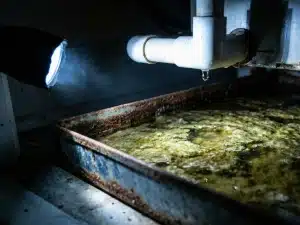
This is the source of 80% of “musty home” calls to restoration companies in the Tampa area. Your A/C’s condensate drain line is a known failure point. While you were gone, it likely clogged with algae (which thrives in our warm climate), causing the drain pan to overflow.
What to Look For:
- Standing Water: Is there water in the emergency drain pan (the metal or plastic pan under your air handler)?
- Water Stains: Do you see water stains on the wooden platform or the nearby drywall?
- Corrosion: Is the unit rusting at the base?
If you see these signs, water has likely been spilling over for months, soaking the structure.
 3. Inspect Under Every Sink
Open the cabinet under your kitchen sink and every bathroom sink. Don’t just look—use your phone’s flashlight and feel the back wall and the bottom of the cabinet.
Check for signs of a slow-drip plumbing leak:
- Is the particleboard bottom soft, “puffy,” or warped?
- Do you see any dark, speckled “black mold” (or any color mold) on the drywall?
- Check the flexible supply lines—are they rusted or damp?
A failure here is often one of the 3 “Silent Leaks” that cause major damage in Florida homes.
4. Scan Ceilings and Corners
Grab that flashlight and do a slow scan of all your ceilings. Pay special attention to the corners where the wall meets the ceiling, and around any A/C vents or light fixtures.
You are scanning for faint, yellowish-brown “water rings.” This is a classic sign of hidden water damage, often caused by a roof leak from those heavy summer storms common to the Gulf Coast. It might look dry now, but the insulation above that spot is likely a wet, moldy mess.
5. Look Behind Your “Big” Stuff
Gently pull the headboard of your bed or your couch an inch or two away from the wall. Check the back of your closets, especially where shoes and leather goods are stored.
These areas have zero airflow, making them a perfect “five-star resort” for mold. High Florida humidity, combined with no A/C, means mold can grow right on the drywall or your personal belongings.
Please, Don’t Just “Clean It.”
If you find visible mold during this inspection, your first instinct might be to grab a bottle of bleach and a sponge.
Please don’t. This is the biggest mistake homeowners make.
- Bleach is the Wrong Tool: Bleach only cleans the surface of non-porous materials (like tile). It does not kill the “root” (mycelium) of mold growing in porous drywall or wood. It bleaches the color out, but the mold is still there and will return.
- You Will Spread It: Scrubbing or spraying dry mold sends millions of spores airborne, contaminating the rest of your home and your HVAC system.
- It’s a Sign, Not the Problem: Mold is a symptom. The problem is the moisture. If you don’t find the water source, the mold will be back in weeks.
Do not run your A/C or ceiling fans if you suspect a large mold issue, as this can spread spores through the entire house.
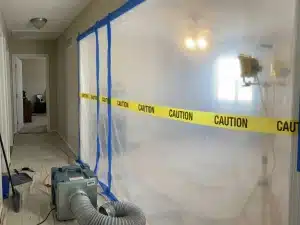
If you smell that smell or see a problem, call a professional team. A certified remediation expert will set up proper containment (plastic barriers) so the mold doesn’t spread, and use HEPA-filtered air scrubbers to clean the air while they work.
How to Prevent This from Happening Next Year
Once you’ve had the current issue professionally remediated, here is your prevention plan for next season:
- Get a “Smart” Thermostat: Install one that you can control from up north. This allows you to monitor your home’s humidity remotely and run the A/C for a few hours a day if levels spike.
- Use a Humidistat: Many A/C pros can install a humidistat that only runs the A/C when humidity levels pass 55-60%, saving energy while protecting your home.
- Hire a “Home Watch” Service: Having a bonded and insured neighbor or professional walk through your home once a month is invaluable. They’ll spot a small roof leak before it becomes a disaster.
- Shut Off Your Water: If you’ll be gone for months, consider shutting off the main water supply to prevent a catastrophic plumbing failure.
 Have a Water, Fire, or Storm Emergency?
You don’t have to handle this alone. The Major Restorations team is here to be your calm expert in the storm. We serve Tampa, Clearwater, and St. Petersburg with 24/7 emergency service, ready to guide you through the entire process, from the first call to the final insurance claim.
Call Us Now: (727) 609-1991
Contact Us for a Non-Emergency Assessment
Frequently Asked Questions | Mold Damage
Q1: What’s the difference between mold and mildew?
A1. Mildew is a specific type of mold that is often grey or white, powdery, and grows on the surface of things. “Mold” is a broader term, and the kind we worry about (like Stachybotrys, or “black mold”) often has deeper roots that penetrate drywall and wood. The truth is, you should treat any musty smell or visible growth as a sign of a water problem and have it inspected. You can read more about the health risks of mold from the CDC.
Q2: I only see a tiny spot of mold. Can’t I just clean it with bleach?
A2. We strongly advise against this. First, bleach doesn’t kill the mold’s “root” in porous materials like drywall. Second, scrubbing mold releases millions of spores into the air, potentially spreading the problem. Third, that “tiny spot” is just the symptom; it’s fed by a hidden water leak that you must find and fix.
Q3: My A/C is running, but my house still feels humid and smells musty. Why?
A3. This often means your A/C drain line is clogged. When it clogs, the water and algae in the drain pan (a perfect mold factory) can be re-aerosolized into your home’s air. It’s a sign your system needs professional inspection.
Q4: Will my insurance pay to fix a mold problem?
A4. It depends. Most policies will cover mold removal if it was caused by a “sudden and accidental” water loss (like a burst pipe). However, they will deny a claim if the mold is from a slow leak or deferred maintenance. The insurance claim process for mold can be tricky, which is why having an advocate is essential.
Disclaimer: Major Restorations is a remediation professional, not a physician or public adjuster. Information regarding mold and insurance coverage is for educational purposes only. Please consult a medical professional for health concerns and your insurance carrier for final policy verification.

