
Water damage isn’t always as dramatic as a burst pipe or a flooded kitchen. In a humid climate like Tampa Bay’s, the most destructive damage caused by water is often the kind you can’t see. It’s the slow, silent leak behind a wall, under a floor, or in an attic.
This hidden moisture can go unnoticed for weeks or months, silently rotting structural wood and cultivating massive mold colonies. The key is to spot the subtle warning signs before a small issue becomes a catastrophic home restoration project. Most homeowners overlook these clues, but a trained eye knows what to look for.
Why “Hidden” Water Damage is So Common in Tampa Bay
Our climate is the main driver. The intense, year-round humidity creates a constant “vapor pressure” on our homes, seeking any way to get in. This means:
- Condensation is Constant: A/C condensate lines, plumbing pipes, and even ductwork can “sweat” in hot attics, creating a slow, steady drip that soaks insulation.
- Leaks are Masked: In a drier climate, a small leak might evaporate. Here, the ambient humidity prevents evaporation, allowing that small leak to saturate building materials.
- Mold Grows Fast: The combination of moisture, heat, and darkness is a perfect recipe. In Florida, mold can begin to grow on a damp surface in as little as 24-48 hours.
5 Telltale Signs of a Hidden Leak
Trust your senses. Your home will almost always tell you when something is wrong.
1. The “Musty” Odor You Can’t Pinpoint
This is the #1 sign, and it’s the one most often ignored. If you get a whiff of a musty, damp, or earthy smell (like damp soil) when you walk in your home or enter a specific room, trust your nose.
That “musty” smell is the off-gassing from active mold growth (MVOCs). It’s literally the smell of a colony eating your home’s organic materials. Because airflow can carry the scent, the smell may be strongest in a room far from the actual leak.
2. Changes to Your Walls and Ceilings (Not Just Stains)
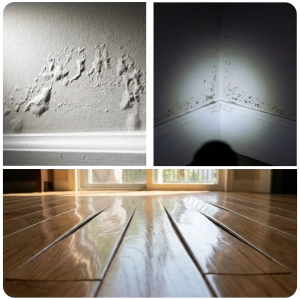 Everyone knows to look for a brown water stain, but the signs are often more subtle. As drywall becomes saturated, its structural integrity fails.
Look for:
- Peeling, bubbling, or cracking paint or wallpaper.
- A “bubbling” or “bulging” texture on the wall or ceiling.
- Damp or “sweaty” spots on a wall, especially one that feels cool to the touch.
- Swollen or bowed drywall, particularly near the baseboards.
3. Warped, Cupped, or Spongy Floors
Your flooring is a major indicator. If you have a hidden plumbing leak (like a slab leak or a leaking dishwasher), the floor will be the first to tell you.
- For Wood: Look for “cupping” (edges of the planks are higher than the center) or “crowning” (the center is higher than the edges).
- For Laminate: You’ll see swelling, warping, or peeling at the seams.
- For Tile: The grout may become cracked, dark, or show signs of white, powdery “efflorescence” (salts being pulled from the concrete).
- For Carpet: You may feel a spongy or damp spot, or the tack strips may rust and discolor the carpet at the edges of the room.
4. A Sudden, Unexplained Spike in Your Water Bill
Your utility bill is a diagnostic tool. If your habits haven’t changed but your water bill suddenly jumps by 20%, 50%, or 100%, you almost certainly have a leak. This could be a running toilet (easy fix) or a more sinister slab leak (a pipe leaking under your foundation). Don’t ignore it.
5. Visible Mold or Mildew (The Obvious Symptom)
This seems obvious, but many people mistake it for “dirt” or “soot”. If you see black, green, or white specks growing in a corner, along a baseboard, or on the back of a closet wall, you are not seeing the problem. You are seeing the symptom.
Mold cannot exist without moisture. Do not just spray it with bleach (this often makes it worse). You must find the water source that is feeding it.
The Dangers of “Waiting It Out”
A hidden leak is a time bomb.
- Structural Damage: Saturated wood studs and subfloors will rot, weakening the structure of your home.
- Mold Infestation: A small, damp spot can become a massive mold colony, which can spread spores throughout your HVAC system, impacting your home’s air quality.
- Insurance Issues: Most insurance policies cover damage that is sudden and accidental. They will often deny claims for damage that is clearly old, which they can determine by the extent of the rot or mold. Waiting turns a covered claim into an out-of-pocket disaster.
Don’t Let a Hidden Leak Rot Your Home
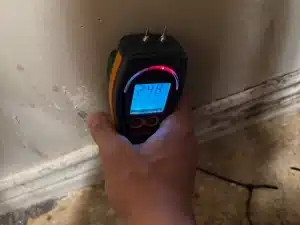 If you smell must, see a stain, or just feel like something is wrong, trust your gut. That 48-hour window is what we call the “golden hours”—the vital time frame to stop moisture before it becomes mold.
A professional assessment is the only way to know for sure.
At Major Restorations, we use specialized tools like thermal imaging cameras and non-invasive moisture meters to “see” behind your walls. We pinpoint the exact source of the moisture without unnecessary demolition, create a plan to fix it, and give you a clear path back to a safe, dry home.
Frequently Asked Questions | Hidden Damage
Q1. I smell a musty odor but I can’t find any mold. What should I do?
A1. Trust your nose. A musty smell is the #1 sign of a hidden problem. The mold could be behind drywall, under flooring, or in your attic. Call a professional restoration contractor to use thermal cameras to find the hidden moisture source without tearing open your walls.
Q2. My water bill spiked, but I don’t see any leaks. Am I imagining things?
A2. No. This is a classic sign of one of the 3 “silent leaks”: a slab leak (a pipe leaking under your foundation). Turn off all your water-using appliances and check your water meter. If the dial is still spinning, you have a leak.
Q3. How long does it take for mold to grow after a water leak?
A3. In the warm, humid Tampa Bay climate, mold can begin to grow in as little as 24 to 48 hours. This “golden window” is why a 24/7 emergency response is so essential.
Q4. Is "hidden water damage" covered by my homeowners insurance?
A4. It depends on the cause. If the damage is from a “sudden and accidental” event (like a burst pipe you couldn’t see), it is almost always covered. If it’s from a slow, neglected leak (like cracked grout you ignored for a year), it will likely be denied. This is why acting fast is so important.
Disclaimer: Major Restorations is a remediation professional, not a physician or public adjuster. Information regarding mold and insurance coverage is for educational purposes only. Please consult a medical professional for health concerns and your insurance carrier for final policy verification.
